
Modern organizations don’t struggle to produce plans. They struggle to keep meaning intact as work unfolds. Execution accelerates, context shifts, and decisions compound — yet most planning systems still assume intent can be stabilized early, alignment can be achieved episodically, feasibility can be assessed once and trusted, and outcomes can be “managed” after the fact.
Those assumptions no longer hold.
Outcome Orchestration is the discipline that replaces them. It provides a way to continuously preserve clarity, alignment, and feasibility so work remains capable of producing the outcome it intends — even as reality changes.
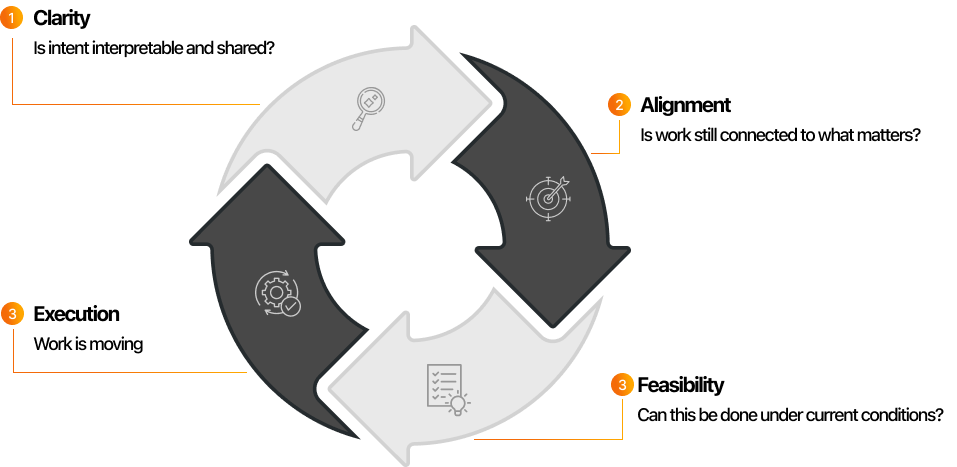
Most project failures are not execution failures. They are understanding failures.
Teams move, work progresses, and artifacts appear complete. But beneath the surface, intent is reinterpreted, assumptions diverge, constraints surface late, and alignment decays without signal. By the time outcomes are evaluated, the cost is already sunk.
Traditional planning tools were built to record activity, not to maintain coherence. Outcome Orchestration exists because modern work requires systems — and leaders — that can keep meaning intact while motion accelerates.
The minimum structure required before commitment forms
Before execution begins, teams must be able to see — quickly — what they are attempting to achieve and whether it is still viable. The 60-Second Standard defines that baseline.
It is not about final answers, approvals, or speed for its own sake. It is about early judgment. Within seconds, a team should be able to surface the intended outcome, the context shaping feasibility, the assumptions carrying risk, and where clarity is missing.
If this cannot be seen early, commitment forms blindly — and drift becomes inevitable.
What structured early signal consistently reveals
Once early project signal is structured, a pattern appears across industries and domains. Most project plans are missing roughly 30% of what actually determines outcome success — not tasks or dates, but meaning.
That missing understanding lives in unspoken expectations, hidden constraints, fragile assumptions, cross-team dependencies, and contextual forces that never made it into the plan. The 30% Rule is not a statistic; it is a lens. It trains leaders to assume something important is missing — and to look for it while it is still cheap to address.
The discipline that integrates judgment, alignment, and outcomes across the lifecycle
Outcome Management helped organizations stop celebrating delivery without value, but it remained largely reactive — assessing outcomes after work was already in motion.
Outcome Orchestration is the next evolution. It is the discipline of continuously maintaining clarity of intent, shared understanding, alignment to outcomes, and honest feasibility before drift hardens into rework, escalation, or failure.
Where Outcome Management asks whether the outcome was achieved, Outcome Orchestration asks whether the work is still capable of producing the intended outcome given what is true right now. That question must be answered continuously.
For years, I watched experienced project leaders work harder than necessary — not because execution was unclear, but because the planning environment made judgment fragile. Every project began with optimism, and then the same questions surfaced: What are we really trying to achieve? What assumptions did we miss? Is this still feasible? Are we actually aligned?
These were not execution failures. They were signals that planning had not evolved alongside speed.
Outcome Orchestration names the work modern project leaders are already doing: preserving meaning, detecting drift early, and restoring alignment before failure becomes visible. This site exists to document that discipline clearly — before it becomes diluted, misapplied, or misunderstood.
OutcomeOrchestration.ai is a canonical reference. It is not a product site, a methodology pitch, or a trend hub. It exists to articulate the discipline required to lead outcome-driven work in environments where static plans can no longer hold.
Additional essays, definitions, and applied perspectives will be published as the discipline continues to take shape.
Join the Intralign Waitlist and Lead the Future of Project Management